
In a world that often seems to be bursting at the seams with possessions and responsibilities, the idea of decluttering has gained immense popularity. From the minimalist movement to the KonMari method, individuals are increasingly recognizing the benefits of simplifying their lives. However, what many fail to acknowledge is the mental and physical toll that decluttering can take. In this blog post, we will delve into why decluttering is so exhausting and explore the psychological factors that contribute to the fatigue associated with this seemingly straightforward task. Plus, I’ll share some tips for how to make decluttering less exhausting.
Welcome to the Year Long Thorough Declutter Series! We will be starting decluttering specific tasks. Each day is dedicated to spending only 30 minutes decluttering your specific daily task. We will be working 5 days a week, so you can take 2 days to enjoy time with your loved ones.
Also, you can get the complete digital printable copy of the Year Long Thorough Declutter Series Calendar and Checklists here. The printable digital download is delivered to your email. It includes 25 pages of printable calendar pages and checklists to help you declutter every room in your home. You can sign up here.
Struggling with the daily housekeeping chores? Check out my ebook on this topic, entitled Make Over Your Homemaking. Use this link to get it at a discounted price.
Why Decluttering is So Exhausting
- Decision Fatigue:
Decluttering is essentially a series of decisions—deciding what to keep, what to donate, and what to discard. The sheer number of choices involved can lead to a phenomenon known as decision fatigue, which is one reason why decluttering is so exhausting. As we make one decision after another, our cognitive resources become depleted, making each subsequent decision more challenging. This exhaustion can leave us feeling mentally drained and overwhelmed, contributing to the perception that decluttering is an exhausting process.
- Emotional Attachment:
Our belongings often hold sentimental value, making it difficult to part with them. Whether it’s an old sweater that reminds us of a cherished memory or a trinket passed down from a loved one, the emotional attachments we form with our possessions can impede the decluttering process. Letting go of items tied to our past can evoke a range of emotions, from nostalgia to guilt, intensifying the emotional toll of decluttering.
- Fear of Wasting:
The fear of wasting resources, money, or even the potential usefulness of an item can create a barrier to decluttering. This fear can lead to indecision, as individuals grapple with the internal conflict of wanting to minimize their possessions while simultaneously fearing the consequences of discarding something that might be needed in the future. This internal struggle adds an extra layer of complexity to the decluttering process, making it more mentally taxing.
- Overcoming Perfectionism:
Perfectionism can be a significant obstacle when decluttering. The desire for an immaculate, organized space can lead individuals to scrutinize every item, agonizing over whether it truly sparks joy or serves a practical purpose. The pursuit of perfection in the decluttering process can be exhausting, as it sets an unrealistic standard that is difficult to achieve.
- Time and Energy Investment:
Decluttering is a time-consuming process that requires sustained effort and energy. Many people embark on decluttering projects without fully realizing the commitment involved. Sorting through years’ worth of belongings, making decisions, and organizing spaces demands both physical and mental stamina. The realization of the time and energy required can contribute to the perception that decluttering is an exhausting endeavor.
While the benefits of decluttering are undeniable—creating a more organized and peaceful living environment—it’s crucial to recognize the challenges and exhaustion associated with the process. By understanding the psychological factors at play, individuals can approach decluttering with a more compassionate and realistic mindset. Ultimately, the journey to a clutter-free life is a marathon, not a sprint, and acknowledging the inherent challenges can make the process more manageable and less mentally taxing. Now, let’s look at how to make decluttering less exhausting.
Can you tell me how to make decluttering less exhausting?
Decluttering can be a daunting task, but there are several strategies you can employ to make the process more manageable and less exhausting. Here are some tips to help you navigate the decluttering journey:
- Start Small: Begin with a small, manageable area rather than tackling an entire room at once. This can help prevent overwhelm and make the process feel more achievable. For example, start with a single drawer, a shelf, or a specific category of items.
- Set Realistic Goals: Establish achievable goals for each decluttering session. Instead of aiming to declutter an entire space in one day, break it down into smaller tasks. This allows you to make consistent progress without feeling overwhelmed.
- Follow the 80/20 Rule: The 80/20 rule, also known as the Pareto Principle, suggests that we use 20% of our possessions 80% of the time. Focus on identifying and keeping the items that fall into this category. This approach can streamline decision-making and reduce the number of choices you need to make.
- Use a Timer: Set a timer for a specific amount of time (e.g., 15 or 30 minutes) and declutter until the timer goes off. Knowing that there’s a defined endpoint can make the process more bearable, and it helps prevent burnout.
- Categorize Items: Sort items into categories before deciding what to keep, donate, or discard. This can make the process more systematic and help you identify duplicates or unnecessary items more easily.
- Enlist Support: Decluttering doesn’t have to be a solitary endeavor. Enlist the help of friends or family members who can provide support, encouragement, and a fresh perspective. Having someone to share the workload can make the task feel less overwhelming.
- Address Emotional Attachments: Recognize that some items may have sentimental value, and it’s okay to keep those that truly bring you joy or hold significant memories. Acknowledge the emotions associated with certain possessions and be mindful of the impact of letting go.
- Create a Sorting System: Establish a clear system for sorting items, such as using labeled bins for “keep,” “donate,” and “discard.” Having a structured approach can streamline the process and reduce decision fatigue.
- Donate or Sell Unwanted Items: Knowing that your belongings will find a new home or that you can make some money by selling them can provide motivation. Consider donating to local charities or selling items online to give your decluttering efforts a purpose.
- Celebrate Progress: Acknowledge and celebrate your achievements along the way. Take breaks, treat yourself to something enjoyable, or reflect on the positive changes you’ve made. Recognizing progress can boost motivation and make the process more rewarding.
Remember, decluttering is a gradual process, and it’s important to be patient with yourself. By incorporating these strategies, you can make the journey less exhausting and more sustainable.
Struggling with the daily housekeeping chores and wondering: What Housework Should Be Done Daily? Grab my free ebook to walk you through the process. What Does a Deep Clean Include? One of my best Deep Cleaning Home Tips is to use a House Cleaning Planner. Check out my ebook on this topic, entitled Make Over Your Homemaking. Use this link to get it at a discounted price. Better yet… get it FREE when you subscribe to my site. Also, you can find my room by room Declutter Guide at the end of this post designed to help you learn tips and Decluttering Ideas For Your Home.
Maybe your house is clean but cluttered. If so, you need to know a few Declutter Tips and Ideas before you start using the Step By Step Decluttering plan I use. Does a Cluttered House Cause Stress? You Bet! Let’s look at a reputable, mental health site to answer that question and see exactly How Clutter Affects You. Then you can learn Why and How To Start to Purge Your Entire Home.They have given us 8 ways mess leads to stress and exactly How Clutter Affects You. According to Psychology Today:
How Clutter Affects You: Clutter can play a significant role in how we feel about our homes, our workplaces, and ourselves. Can a Messy House Affect Your Mood? You bet! How Does Clutter Affect Your Life? Messy homes and work spaces leave us feeling anxious, helpless, and overwhelmed. Yet, rarely is clutter recognized as a significant source of stress in our lives. (source) But, unnecessary stress is one aspect of How Clutter Affects You.
How Clutter Affects You Mentally can help provide the motivation you need to know How to Clear Clutter and Get Organized. Why does mess lead to so much stress? (source)Getting rid of all of that stress can be one of the best declutter motivation tips you need for some instant Declutter Inspiration.
- Clutter bombards our minds with excessive stimuli (visual, olfactory, tactile), causing our senses to work overtime on stimuli that aren’t necessary or important. (source)
- Clutter distracts us by drawing our attention away from what our focus should be on. (source)
- Clutter makes it more difficult to relax, both physically and mentally.(source)
- Clutter constantly signals to our brains that our work is never done.(source)
- Clutter makes us anxious because we’re never sure what it’s going to take to get through to the bottom of the pile. (source)
- Clutter creates feelings of guilt (“I should be more organized”) and embarrassment, especially when others unexpectedly drop by our homes or work spaces. (source)
- Clutter inhibits creativity and productivity by invading the open spaces that allow most people to think, brainstorm, and problem solve.(source)
- Clutter frustrates us by preventing us from locating what we need quickly (e.g. files and paperwork lost in the “pile” or keys swallowed up by the clutter). (source) So, experiencing constant frustration is another aspect to How Clutter Affects You.
Overwhelmed by a Messy House? It can really affect you negatively. How Do You Deal With a Cluttered Mess? One way is to have a plan, set aside a specific time, and learn the steps to declutter your home. What Cleaning Should Be Done Daily? I have a room by room specific Printable House Cleaning Checklist linked above. Also, you can find my room by room Declutter Guide at the end of this post.
For a clean, simplistic look, one of the best Deep Cleaning Home Tips is to declutter a room before cleaning and then use an Easy House Cleaning Schedule to maintain it. Declutter Checklists can help you learn How to begin to Purge Your Entire Home.
How Does Clutter Affect Your Life? As you can already see, there are at least 8 ways we become negatively affected by clutter. Also, I though it might be thought provoking to look at some statistics on clutter to learn more about How Clutter Affects You.
- US consumers buy 40% of the world’s toys, but bear only 3% of the world’s children.
- Most people wear 20% of their clothing 80% of the time. (source )
- 9.4% of U.S. households rent a storage unit. (source)
- People do not look at 80% of the papers and information they keep.(source)
- The average American house is double the size it was in the 1950s–and getting bigger. (source.)
- The U.S. Department of Energy reports that one-quarter of people with two-car garages have so much stuff in there that they can’t park a car. (https://www.becomingminimalist.com/the-statistics-of-clutter/)
- According to the National Soap and Detergent Association, getting rid of clutter would eliminate 40 percent of housework in the average home.(https://www.becomingminimalist.com/the-statistics-of-clutter/) Wouldn’t eliminating a lot of housework provide some declutter inspiration? Read on for more Decluttering Ideas For Your Home.
Today, we’ll lay out the solutions for the steps to declutter using my tips on Why and How to Declutter a House. Plus, we’ll look at a few ways to answer the concern of How Clutter Affects You and what you can do about it.
A few guidelines to keep you on task:
1.Only spend time on your specific daily task.
2.Do not get side-tracked or distracted.
3.Work within a time of day that you have the most energy and stamina.
4.Avoid thinking too long about whether to keep or discard an item. Recruit help if you are stuck in the decision process.
5.Avoid cleaning during your declutter. Getting rid of the clutter is your priority. Cleaning can be accomplished later.
We are working in the 2nd bathroom this week. Your task today for today, January 20th is to: Declutter any unused or torn shower caps.
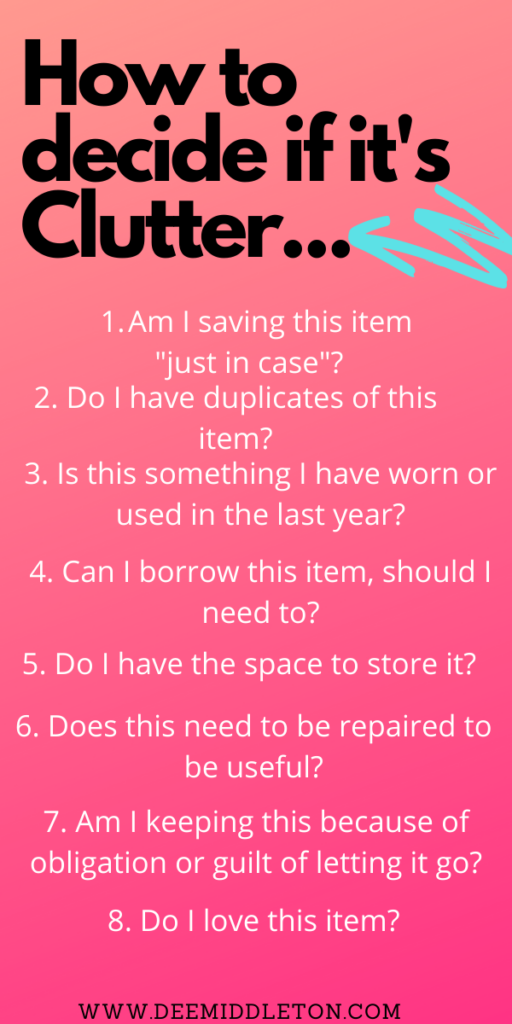
Struggling to decide if an item is clutter? Use these questions below to help you determine whether to keep or toss any item.
Need to deep clean? I have lists for you to guide you along.
My How to Deep Clean Your Kitchen list can be found here.
My How to Deep Clean Your Bathroom list can be found here.
My How to Deep Clean Your Kids’ Rooms list can be found here.
My How to Deep Clean Your Living Room list can be found here.
My How to Deep Clean Your Bedroom list can be found here.
Also, to keep up the general housework, you may need to create a daily housekeeping schedule that suits your specific needs. To do so, I have created a helpful series you can read here.
Need to Declutter Every room? I have declutter checklists for every room and every space in your home to guide you along below.
Also, you can get the complete digital printable copy of the Year Long Thorough Declutter Series Calendar and Checklists here. The printable digital download is delivered to your email. It includes 25 pages of printable calendar pages and checklists to help you declutter every room in your home. You can sign up here.
How to Declutter the Guest Room or Your Kid’s Room checklist can be found here.

How to Declutter Your Laundry Room and Patio checklist can be found here.
How to Declutter Your Coat Closet/Hall Closet/Linen Closet checklist can be found here.
How to Declutter Your Home Office checklist can be found here.

How to Declutter Your Attic checklist can be found here.
How to Declutter Your Garage checklist can be found here.
How to Declutter Your Living Room checklist can be found here.
How to Declutter Your Kitchen Checklist can be found here.

How to Declutter Your Entry/Foyer/Mudroom checklist can be found here.
How to Declutter Your Clothing checklist can be found here.
How to Declutter Your Bedroom checklist can be found here.
How to Declutter Your Bathroom checklist can be found here.

Happy Decluttering!
To Subscribe to this Declutter Series, drop me a comment below. Your email will be sent to me but will not be posted publicly. You’ll receive a daily declutter task via email for the daily task we are working on. You can unsubscribe at any time.
New to deemiddleton.com and don’t know where to start? I recommend going in this order:
Step 1: Check out this post on the 1st step you should take to get organized. If you don’t have a calendar, you can grab my free weekly printable calendar page here. It is in my shopify store, but it is totally free, so you won’t be prompted to put in any payment information. It is a free download and will be delivered straight to your email.
Also, you can get the complete digital printable copy of the Year Long Thorough Declutter Series Calendar and Checklists here. The printable digital download is delivered to your email. It includes 25 pages of printable calendar pages and checklists to help you declutter every room in your home. You can sign up here.
Step 2: Create a daily Housekeeping Schedule. You can use this series to start to set up your own schedule. You can also use this simplified weekly schedule.If you often ask: What is the fastest way to clean a dirty house? Or, if you struggle to get organized and have tried and failed time and again, you can likely find out which of these 11 reasons cause you to fail to get organized.
Step 3: How do you remove clutter?.…Sign up for the Declutter Series and get your entire home decluttered in just 30 minutes a day, 5 days a week.”Declutter Your Home” checklists are provided in each email.
Step 4: What is the fastest way to clean a dirty house? Use a timer and use the Deep Cleaning Checklists above. They will help you get your home sparkling after you’ve decluttered.
Interested in becoming a full-time blogger like me? Check out my blogging series. At the top of every page on my blog, you’ll find a drop down menu. Just select the BLOGGING category.
Check out the most popular posts on deemiddleton.com:
14 Things That Make Your Home Look Cluttered
How to Create a Daily Housekeeping Schedule
How to Clean House When You Are Completely Overwhelmed By Clutter
What is Preventing You From Getting Organized?
Also, check out a great post on decluttering over here from becomingminimalist.com. Joshua Becker has some great tips on decluttering and minimalism.
For further reading, check out the fly lady here. She has some great cleaning and kitchen decluttering ideas plus excellent organization tips to get you started.
I hope you have benefitted from my post on Ways to Declutter (tasks you can do in 30 minutes). Leave a comment below to subscribe to my daily declutter task email series.
Recent Comments