
In today’s digital age, the need for a home filing system might seem obsolete, but it remains an essential tool for keeping your important documents organized and easily accessible. Whether you’re managing personal finances, important medical records, or simply want to declutter your living space, creating an effective home filing system is a smart move. In this blog post, we’ll provide you with valuable tips on how to create a home filing system that works for you.

Welcome to the Year Long Thorough Declutter Series! We will be starting decluttering specific tasks. Each day is dedicated to spending only 30 minutes decluttering your specific daily task. We will be working 5 days a week, so you can take 2 days to enjoy time with your loved ones.
Also, you can get the complete digital printable copy of the Year Long Thorough Declutter Series Calendar and Checklists here. The printable digital download is delivered to your email. It includes 25 pages of printable calendar pages and checklists to help you declutter every room in your home. You can find that here.
Struggling with the daily housekeeping chores? Check out my ebook on this topic, entitled Make Over Your Homemaking. Use this link to get it at a discounted price.

Tips to Create a Home Filing System
- Gather Your Supplies
Before diving into organizing your documents, gather the necessary supplies. You’ll need:
- File folders (both letter-sized and legal-sized)
- Hanging file folders
- A file cabinet or storage box
- Labels or a label maker
- A filing system guide (for creating categories
- A fireproof safe (I’ll cover what papers to keep in the fireproof safe below)
Having all these materials ready will make the process smoother.
- Declutter and Sort
The first step to creating an effective filing system is to declutter your existing documents. Go through all your papers and determine what’s important and what can be discarded. Make three piles: keep, shred, and recycle.
Once you’ve decluttered, sort your important documents into categories. Common categories include:

- Financial documents (e.g., bank statements, tax records)
- Personal identification (e.g., passports, birth certificates)
- Medical records (e.g., insurance documents, prescriptions)
- Home-related paperwork (e.g., mortgage documents, utility bills)
- Legal documents (e.g., wills, contracts)
- Create a Filing System Guide
To ensure consistency in your filing system, create a guide that outlines the categories you’ve chosen. You can use a notebook or a digital document for this purpose. List each category and include subcategories if necessary. This guide will serve as a reference point when filing and retrieving documents.
- Use a Color-Coding System
Color-coding your file folders can be a game-changer. Assign a specific color to each category or subcategory, making it easier to identify and locate documents quickly. For instance, you might use green folders for financial documents, red for medical records, and blue for personal identification.
- Invest in a Quality Filing Cabinet or Box
Choose a filing cabinet or storage box that suits your needs and space constraints. If you have limited space, consider a compact file box that can be easily stored in a closet or under a bed. Ensure that your chosen storage solution is durable and capable of protecting your documents from damage.

- Label Everything Clearly
Neat and clear labeling is the key to an efficient filing system. Use legible, large-font labels for your file folders and hanging file folders. Include the category and any relevant subcategory on the labels. If you prefer, invest in a label maker for a professional look.
- Regularly Review and Maintain
Your home filing system is not a “set it and forget it” task. Regularly review your documents and file new ones promptly. Set aside time every month or quarter to declutter and ensure that everything is in order. This habit will save you time and reduce clutter in the long run.
- Digital Backups
While a physical filing system is crucial, consider creating digital backups of essential documents. Scan and store electronic copies in a secure and organized manner. This redundancy can provide added peace of mind in case of physical document loss or damage.
Creating a home filing system may require some initial effort, but the benefits are worth it. It helps you stay organized, reduces stress when searching for important documents, and provides a sense of control over your personal information. By following these tips and maintaining your system regularly, you’ll have a well-organized home filing system that serves you effectively for years to come.
Home Filing System Tip: What papers should I keep in a fireproof safe?
A fireproof safe is an excellent investment for safeguarding important documents and valuables in the event of a fire or other disasters. While it’s crucial to keep a variety of documents secure, it’s equally important not to overfill your safe, as this could make it difficult to retrieve items quickly when needed. Here’s a list of documents and valuables you should consider keeping in a fireproof safe:

- Identification Documents:
- Birth certificates
- Passports
- Social Security cards
- Citizenship papers
- Marriage certificates
- Financial Documents:
- Wills and trusts
- Property deeds and titles
- Car titles
- Life insurance policies
- Mortgage documents
- Recent tax returns (consider electronic copies as well)
- Stocks, bonds, and other investment certificates
- Estate Planning Documents:
- Durable power of attorney
- Healthcare power of attorney
- Living wills
- Trust agreements
- Insurance Policies:
- Homeowners/renters insurance policies
- Health insurance policies
- Auto insurance policies
- Valuable item insurance policies (e.g., jewelry, art)
- Banking Information:
- Bank account information (account numbers, passwords)
- Safe deposit box information
- Medical Records:
- Copies of medical records
- Health insurance cards
- Valuables:
- Jewelry
- Family heirlooms
- Collectibles
- Rare coins or currency
- Electronic Media:
- External hard drives or USB drives with important digital files
- Backup copies of important documents and photos
- Other Important Records:
- School transcripts and diplomas
- Military records
- Adoption papers
- Spare Keys:
- Spare keys for your home, car, or other properties
- Emergency Cash:
- A small amount of cash in case of emergencies.
It’s important to note that while a fireproof safe can protect your documents from fire damage, it may not be as effective against theft. For additional security, consider a home security system or a separate, hidden safe for more valuable items.
Furthermore, regularly review and update the contents of your fireproof safe. Documents and valuables that are no longer relevant or necessary should be removed to make room for new items. Additionally, it’s a good idea to inform a trusted family member or friend about the existence and location of your safe in case they need access to it during an emergency.
A few guidelines to keep you on task:
1.Only spend time on your specific daily task.
2.Do not get side-tracked or distracted.
3.Work within a time of day that you have the most energy and stamina.
4.Avoid thinking too long about whether to keep or discard an item. Recruit help if you are stuck in the decision process.
5.Avoid cleaning during your declutter. Getting rid of the clutter is your priority. Cleaning can be accomplished later.
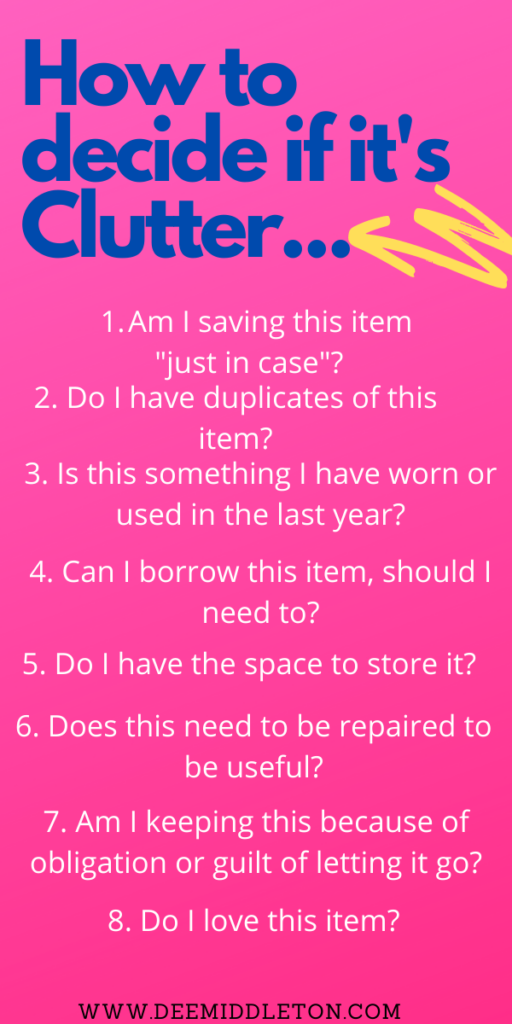
Struggling to decide if an item is clutter? Use these questions below to help you determine whether to keep or toss any item.
Complete Home Declutter: HOW TO DECLUTTER:
Supplies Needed:
1. boxes -preferably ones you can donate (Avoid plastic storage bins because you may be tempted to just store the items and not part with them.)
2. sturdy trash bags
3. marker/pen to label boxes
Decluttering Tip: Avoid using storage bins to declutter. Storage bins tend to tell your brain to “store” the items for later. That is just delaying decisions. If you aren’t getting rid of items when you declutter, you are not truly decluttering. This is why I recommend a trash bag, also. A trash bag tells your brain to “trash” the item.
Obviously, recycle if you have that option. The boxes you use should be ones you are willing to part with, so I recommend sturdy cardboard boxes. As to donations, there are many charities that will come pick up your items for you at your home.
I use one in particular where you can book an appointment for pick-up online. This is so convenient, as it saves you the hassle of hauling stuff away yourself. Scheduling that pick-up also motivates you to declutter by a certain date.
How to Declutter:
1. Start by eliminating trash first- use a sturdy trash bag
2. Sort items by category if needed so you can see what you have
3.Get rid of duplicate items, broken items, outgrown clothes and shoes, anything you’ll never use again
4. Box up the donations and trash/recycle the rest
5.Select a charity to donate your items and schedule the pick-up if that is an option
We are working in the home office this week. Your task today for today, February 5th is to: Declutter any power cords that no longer serve a purpose.
Bonus tip: Scan all your paper files all with your smart phone into my favorite “paperless” phone app – Evernote. Even if you plan to keep some important documents, this a great way to keep those items stored digitally in case of a fire or natural disaster.
Need to deep clean? I have lists for you to guide you along.
My How to Deep Clean Your Kitchen list can be found here.
My How to Deep Clean Your Bathroom list can be found here.
My How to Deep Clean Your Kids’ Rooms list can be found here.
My How to Deep Clean Your Living Room list can be found here.
My How to Deep Clean Your Bedroom list can be found here.
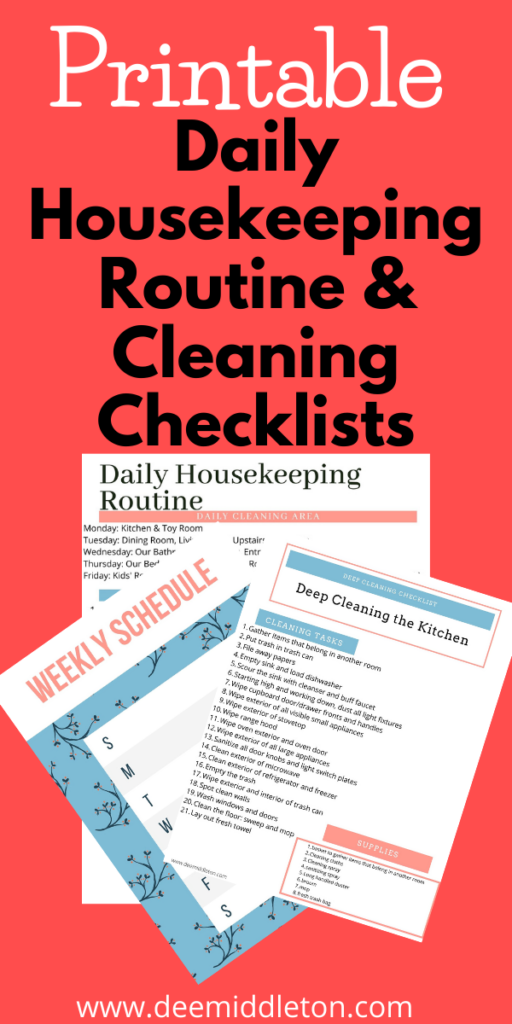
You can get your printable Daily Housekeeping Routine and Deep Cleaning Your House Schedule here. This 15 page printable kit is delivered digitally to your email for you to print and personalize. What Does a Deep Clean Include? It includes a daily schedule, calendar pages, and deep cleaning checklists for every room and area of your home. Below is a sample page of what you’ll get in my Housekeeping Schedule for Home printables.
Also, to keep up the general housework, you may need to create a daily housekeeping schedule that suits your specific needs. To do so, I have created a helpful series you can read here.
Need to Declutter Every room? I have declutter checklists for every room and every space in your home to guide you along below.
Also, you can get the complete digital printable copy of the Year Long Thorough Declutter Series Calendar and Checklists here. The printable digital download is delivered to your email. It includes 25 pages of printable calendar pages and checklists to help you declutter every room in your home. You can sign up here.
How to Declutter the Guest Room or Your Kid’s Room checklist can be found here.

How to Declutter Your Laundry Room and Patio checklist can be found here.
How to Declutter Your Coat Closet/Hall Closet/Linen Closet checklist can be found here.
How to Declutter Your Home Office checklist can be found here.

How to Declutter Your Attic checklist can be found here.
How to Declutter Your Garage checklist can be found here.
How to Declutter Your Living Room checklist can be found here.
How to Declutter Your Kitchen Checklist can be found here.

How to Declutter Your Entry/Foyer/Mudroom checklist can be found here.
How to Declutter Your Clothing checklist can be found here.
How to Declutter Your Bedroom checklist can be found here.
How to Declutter Your Bathroom checklist can be found here.
Happy Decluttering!
To Subscribe to this Declutter Series, drop me a comment below. Your email will be sent to me but will not be posted publicly. You’ll receive a daily declutter task via email for the daily task we are working on. You can unsubscribe at any time.
New to deemiddleton.com and don’t know where to start? I recommend going in this order:
Step 1: Check out this post on the 1st step you should take to get organized. If you don’t have a calendar, you can grab my free weekly printable calendar page here. It is in my shopify store, but it is totally free, so you won’t be prompted to put in any payment information. It is a free download and will be delivered straight to your email.

Also, you can get the complete digital printable copy of the Year Long Thorough Declutter Series Calendar and Checklists here. The printable digital download is delivered to your email. It includes 25 pages of printable calendar pages and checklists to help you declutter every room in your home. You can sign up here.
Step 2: Create a daily Housekeeping Schedule. You can use this series to start to set up your own schedule. You can also use this simplified weekly schedule.If you often ask: What is the fastest way to clean a dirty house? Or, if you struggle to get organized and have tried and failed time and again, you can likely find out which of these 11 reasons cause you to fail to get organized.
Step 3: How do you remove clutter?.…Sign up for the Declutter Series and get your entire home decluttered in just 30 minutes a day, 5 days a week.”Declutter Your Home” checklists are provided in each email.
Step 4: What is the fastest way to clean a dirty house? Use a timer and use the Deep Cleaning Checklists above. They will help you get your home sparkling after you’ve decluttered.
Interested in becoming a full-time blogger like me? Check out my blogging series. At the top of every page on my blog, you’ll find a drop down menu. Just select the BLOGGING category.
Check out the most popular posts on deemiddleton.com:
14 Things That Make Your Home Look Cluttered
How to Create a Daily Housekeeping Schedule
How to Clean House When You Are Completely Overwhelmed By Clutter
What is Preventing You From Getting Organized?
Also, check out a great post on decluttering over here from becomingminimalist.com. Joshua Becker has some great tips on decluttering and minimalism.
For further reading, check out the fly lady here. She has some great cleaning and kitchen decluttering ideas plus excellent organization tips to get you started.
I hope you have benefitted from my post on Ways to Declutter (tasks you can do in 30 minutes). Leave a comment below to subscribe to my daily declutter task email series.
Recent Comments